Thursday, June 2, 2011

Diamond Prices

Before you head off to buy a diamond, you must understand how a diamond is priced. First of all, you have to be aware that a diamond is a commodity. Commodities (like gold, wood, silver, etc.) have fair prices.

A diamond's fair priced is determined is determined by many factors relating to the 4Cs (and beyond). So, you should familiarise yourself with the 4Cs before you buy any diamonds. Else you will most likely be overcharged.


The Rapaport Diamond Price Report™ (Rap Report)

Most diamond business agreements and dealer sales are based on Rapaport prices. Almost all negotiations on diamond prices in the trade are based on the Rapaport report.

Martin Rapaport owns the company that produces the report. The Rapaport Diamond Price Report™ became the benchmark for diamond prices when his price list gained popularity during the 1979-80 commodity boom when 1.00ct D Flawless reached a dealer price of $36,000 (twice today's list price).

Martin Rapaport has since built a substantial diamond information and service business. He has a sizeable diamond business himself, and therefore is not short of information. Whether he sets or reports these prices to his personal benefit is questionable. However, he has a great incentive to report them fairly because his diamond information empire hinges on the credibility of these reports.

As consumers, it does not matter how Rapaport arrives at the prices. The fact remains that every dealer and diamond merchant uses Rap. So, it is the starting point of all discussions on price.

How to use the Rap Report

Assume that I found a potential diamond with the following qualities:

Carat Weight: 0.58ct
Colour: D
Clarity: VVS2

I will then locate the corresponding carat weight category of the Rap Report, like the chart below. (Note that the chart below is fictitious. Rap Reports are copyrighted and I cannot reproduce it. For a real report, ask your jeweller for one.)

ROUNDS Rapaport: (.5 - .69 CT): XX/XX/04    
  IF VVS1 VVS2 VS1 VS2 SI1 SI2 SI3 I1 I2 I3  
D 77 62 56 49 45 39 31 27 21 16 11 D
E 62 56 52 47 44 37 29 25 20 15 10 E
F 56 52 49 44 40 34 27 23 19 14 10 F
G 52 47 44 40 35 30 24 21 17 13 9 G
H 46 41 37 34 30 27 22 20 16 12 9 H
I 38 34 31 28 26 23 21 19 15 12 9 I
J 30 28 27 24 23 21 20 17 14 12 8 J
K 26 25 24 21 20 18 17 16 13 11 8 K
L 23 22 22 20 20 18 16 15 11 10 7 L
M 20 19 19 18 18 16 15 13 10 9 6 M

That the chart above is for diamonds from 0.5ct to 0.69ct. The Rap Report is made up of many charts above. Each chart covers a carat weight range. Prices are quoted on a per carat basis. There other also prices for most shapes of diamonds.

After locating the correct chart, we look for the corresponding value for D and VVS2. In the chart above, it's '56', which means US$5,600 per carat.

We apply the following calculation: US$5600 x 0.58ct = US$3,248.

Hence, we have found out that the 0.58ct, D colour, VVS2 diamond has a Rap Price of US$3,248 as at a particular date.

Adjustments to Rap Price

The Rapaport Diamond Report™ and The Diamond Price Report™ are trade price market analysis and indicator tools of high cash asking prices. Price reports do not factor in higher prices for better proportions and finish or lower prices for poor proportions / cut, etc.

As with most trades, professional diamond dealers trade diamonds and negotiate prices based on their individual knowledge of the diamonds. The dealer who has superior knowedge would be able to negotiatiate better deals over poorly informed ones.

As a consumer, it is impossible to get a good deal when buying diamonds because of our limited knowledge. However, we can avoid being blatantly overcharged by understading fully what I have said in the section on the 4Cs, and how diamond prices are adjusted according to cut quality.

Below, is a chart of very rough indication of fair retail prices of diamonds in the USA, according to the AGS cut grades.

Cut Quality
% of Rap Price
AGS Cut Grade of 7-10 and esp. due to pavilion 75% - 80%
AGS Cut Grade of 5,6 84% - 86%
AGS Cut Grades of 3,4 87% - 90%
AGS Cut Grades 1 &2 91% - 96%
Ideal Cut (AGS000 for cut) 98% - 106%
Ideal Cut (AGS000 for cut), Hearts & Arrows 107% - 110%

Please note that these numbers are only very rough guides, and I cannot assume any liabilities for them. Diamond dealers know the limitations in diamond cut gradings and they know how to adjust their pricing in view of the actual flaws of the diamonds. In addition, there are many other factors, like fluorescence that can affect the price of a diamond. Consumers who rely blindly on cut grading on diamond certificates face a high chance of being ripped off.

It is also interesting to note that the price of a diamond varies with the lab that certifies the diamond. An AGS certified diamond is a little more expensive compared with an GIA certified diamond at one time, all other things being similar.

Using the same diamond discussed above, assuming that the 0.58ct, D Colour, VVS2 diamond is graded AGS Ideal for cut, and displays Hearts & Arrows as well. The fair retail price could be around 110% (assuming no other flaws are present). If the craftsmanship of the diamond is superb because it is cut by a well know cutting factory, it may command a slightly higher premium. Assuming that the fair price is 115%, the price of the diamond would be (US$3,248 x 115%) = US$3,735.2.

If anyone tries to sell you a 0.62ct, D Colour, VVS2 diamond for anything more that US$3,735.2 (in the above situation), be very wary, since one with the very best cut should not cost more than that. Dealers usually buy their diamonds below Rap Prices. If the diamond is cut to extremely high quality (eg. shows no obvious flaws in diamond scans, shows Hearts & Arrows Symmetry and immaculate Lightscope/Idealscope image), the vendor may buy their stock above Rap, particularly if the carat weight is in a popular range. But that is not regular. So, at US$3,735.2, the retailer is making a decent profit already. Consequently, a diamond with a poorer cut should be given a discount as well.

If you buy your diamond from a shop that is located in malls with expensive rent, expect the markup to be higher since they have to pay the expensive rent, as well as the friendly sales staff that serve you tea, and give you the royal treatment. If you buy from an internet store, you should expect the markup to be lower, since they have lower overheads. You can also expect prices to be higher for vendors who give you more information since the equipment (and time) used to prepare the information are costly. Some of these help you select a better diamond. Some of these make you feel good. It is up to you how you want to spend your money.

Rap prices can serve as a defensive tool for consumers, but it can also work against them Some jewellers will tell you that they are selling you a particular diamond at 20% below its Rap Price per se, but you may be getting a bad deal from it because of bad cut, or some other optical flaw that cannot be objectively measured. You can never win when you buy a diamond. The whole idea is not to lose too much.

DNA of H&A Diamonds

In the mid 90’s, we began to import these diamonds to America, we realized that branding was an expensive and time-consuming venture. We believed these incredible diamonds, known in the trade as “Hearts and Arrows” could stand on their own merit, without a fancy name, based simply on their sheer beauty & perfection in cutting. Shakespeare said: “That which we call a rose, by any other word would smell as sweet." Years later, these diamonds have become the foundation of more than a dozen diamond brands with names connoting love and romance and containing words like: Hearts, Arrows, Love, Cupid, etc.
As jewelers began to offer these diamonds in America they did not have to choose between selling the “sizzle or the steak”...these diamonds had both!

These spectacularly beautiful diamonds out shined the competition, scored the highest grades in light performance, garnered the top cut grades in leading gem labs and finally that ‘cool hearts and arrows pattern” simply was “the exclamation point” on an already exciting story.

Take a closer look at Hearts & Arrows... 

The DNA of Hearts & Arrows

The five main components involved in creating a Hearts and Arrows Ideal are summarized below. It is assumed that the diamond must be very round and have exceptional symmetry. It should be understood that excellent polish and symmetry alone is not enough to qualify for H&A status. Cutting Hearts and Arrows is very difficult. The H&A pattern is quite sensitive to symmetrical imperfections. Because of the high degree of symmetry and the limited proportion sets for which the patterns are visible, cutters often settle on cutting for GIA Excellent or some other premium cut instead of committing the time and weight loss necessary to produce a super ideal H&A diamond. Exceptional Optical Symmetry created by these five component parts working together in harmony is responsible for the diamond’s exceptional light performance as well as the sharp, well-formed Hearts and Arrows pattern.

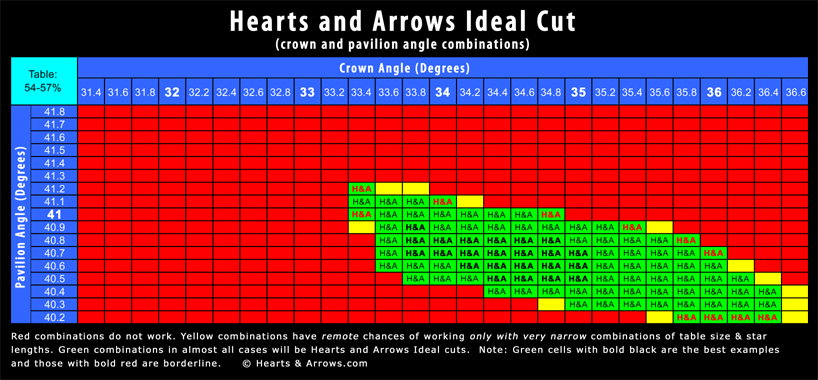
Hearts and Arrows diamonds Ideal Cut Crown and Pavilion Angle Combinations Chart
Fig CH-1
 
Fig CH-2 below shows the parts of the diamond that must work in harmony when manufacturing H&A diamonds.
Parts of the diamond that must work in harmony when manufacturing Hearts and Arrows diamonds
Fig CH-2

1.) Pavilion Angle

Pavilion Angle: range 40.2° - 41.2° (40.6° - 40.8° is optimum)
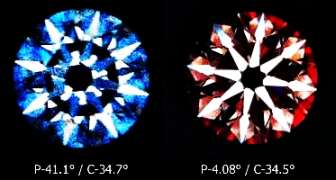
The most important factor in light performance in diamonds is proper bottom angles. Tolkowsky sighted pavilion angles of 40.75° and modern optical science has confirmed these angles to be mathematically sound. The pavilion main facets are like eight mirrors all angled in such a way to reflect light that enters a diamond at vertical angles from 0° to 15° from it’s axis. When the pavilion main facets of a diamond are angled too steep, they will not reflect maximum light back to the viewer. In fact, when these angles exceed 41°, the shaft part of the arrows begins to disappear. It is difficult to have bright evenly colored arrows in the H&A viewer, as these facets are beginning to reflect off the walls of the viewer instead of the white ring at the top. “Angle symmetry”, which refers to all of the facets of a group being cut at the same angle, is imperative in maintaining optical symmetry, so that all eight arrows “light-up” at the same time. Fig B-1
See crown and pavilion combinations chart above Fig CH-1
All 8 Hearts and Arrows diamond arrows lighting up at the same time
Fig B-1


2.) Crown Angle

Crown angle: range 33.4° - 36.4° (34° - 35° is optimum)
The crown angle works in harmony with the pavilion angle. If the pavilion angle is slightly steeper than optimum, a shallower crown angle must compensate for this. Conversely, a shallow pavilion angle can be balanced with a slightly steeper crown angle. However, a combination of a steep crown angle and a steep pavilion angle creates problems and would never be found in an H&A stone. For reasons like this, the AGS laboratory abandoned their “legacy” proportion system for their present light performance method. A good illustration of this is shown in the following example: A diamond with a 41.1° pavilion angle coupled with the 35° crown angle would have garnered an AGS 0 proportion grade, but has no chance for H&A due to the combination of pavilion and crown angle. The chart Fig CH-1 above shows crown angles that work in combination with specific pavilion angles that are imperative to creating bright H&A patterns while delivering superior light performance.


3.) Table Size

Table Size: 53% To 58% (54%-57% is optimum)
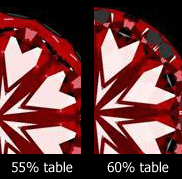
The table size of a diamond affects both light performance and H&A pattern. In the arrows view, the table size affects the size of the table reflection (star) in the center of the stone at the culet. Fig B-6 It also affects the shape of each of the eight hearts by rounding off the shoulders of each heart. Fig B-5 Shows how the heart’s shoulders are squared-off and improved by the smaller table.
Hearts and Arrows diamond heart shoulders are squared-off and improved by the smaller table
Fig B-5
Table size of Hearts and Arrows diamond affects the size of the table reflection (star) in the center of the stone at the culet
Fig B-6


4.) Lower Girdle Halves

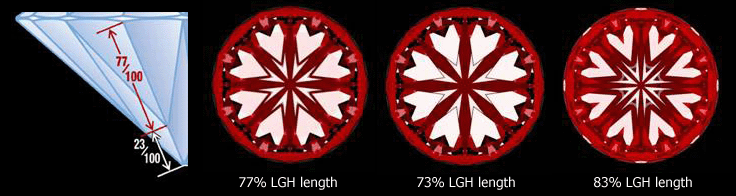
Lower Girdle Halve length: 75% To 80% (77% is optimum)
The real secret to the Hearts and Arrows pattern lies in the creation of these 16 facets of the pavilion. This parameter is crucial in the process of creating the heart shapes. These carefully placed facets produce the eight pavilion mains that are the foundation on which both the hearts and arrows are created. It is imperative that all lower girdle halves are cut to exactly the same length and angle, or the resultant pavilion mains will vary in size and shape and will create crooked hearts and crooked arrows. Fig B-8
Lower girdle halves of Hearts and Arrows diamonds must be cut to exactly the same length and angle
Fig B-8


5.) Star Facets

Star Facet Length: 40% To 58% (45%-50% is optimum)
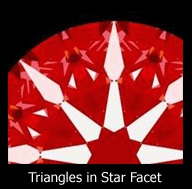
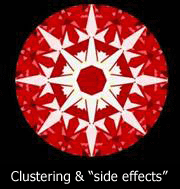
Star facet length is a little known factor in brillianteering that can impact the hearts or arrows pattern. In the heart view, the star facets round off the shoulders or lobes of the hearts, which directly relates to the size of the table. In the arrows view, each star facet contains two small pairs of triangles that are visible between the eight arrowheads. Fig B-9 Long star facet lengths will create problems in cutting the Hearts and Arrows Ideal. If the star facets are too long, they will create the negative effect called “clustering and interference figures”. This disturbs the typical pattern of the arrowhead and shaft area of the eight arrows by adding white reflections that alter the normal H&A pattern. Fig B-10
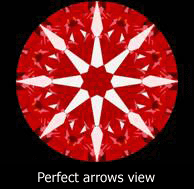
“Clustering” or interference figures can be exaggerated by a combination of long star facets >55%, lower girdle halves >77% along with steeper pavilion angles. This negative factor makes the arrows pattern unacceptable as shown in Fig B-11. The “perfect arrows view” below is much cleaner in appearance due to star facets that fall between 45%-50%. Fig B-12

Hearts and Arrows diamond triangles in Star Facet
Fig B-9
Clustering around shaft of Hearts and Arrows diamond
Fig B-10
Clustering and side effects of Hearts and Arrows diamond
Fig B-11
Perfect Arrows View of Hearts and Arrows diamond
Fig B-12
 

Hearts and Arrows Diamonds

Hearts and Arrows Diamonds are the most beautiful diamonds in the world. The secret to their beauty is revealed here! 

Hearts and Arrows Diamond For centuries, diamonds have remained the ultimate symbol of love. When a man buys an engagement ring or diamond gift, the goal should be to find a diamond as beautiful and special as the one who will receive it.

Hearts and Arrows diamonds are unmatched in precision, beauty and perfection in cutting. They offer edge-to-edge “electric” brilliance with explosions of white and colored light, even in low light conditions i.e. from across the room at a party or a candle-lit restaurant. While delivering high brilliance, fire and sparkle, they are superior in returning the maximum light back to the eye. Computerized light technologies covered in this website have proven that Hearts & Arrows quite simply outshine the competition! The phenomenal brilliance of these incredible gems makes them appear larger and whiter than other fine cut diamonds of the same size. Buyers recognize that the extraordinary brilliance of a Hearts & Arrows Diamond is so superior, that it’s not necessary to buy the highest grade to have a gorgeous diamond!

Hearts and Arrows are not for everyone. They are for the individual that seeks the best in everything and won't settle for second best. True Hearts & Arrows are rare and limited in production; so only select jewelers can offer them. These new age, high tech creations are not your Father’s diamonds, so you don’t have to settle for an “old school” diamond from the last millennium. You can own a masterpiece that is extraordinary in brilliance and sparkle like none other. Our website will guide you in your quest for the best. Seek out and buy a Hearts & Arrows Ideal Cut Diamond. No ordinary diamond can match the fire it will light in a woman's heart.
 
Hearts and Arrows Diamonds are cut to ideal proportions with superior optical symmetry and a specific faceting pattern. When all these factors are in harmony the result is a repeatable, near perfect pattern of eight symmetrical arrows in the face up position and eight symmetrical hearts when viewed in the table down position.

The original Hearts and Arrows were diamonds that embodied three important design factors. First, they were cut to “Ideal proportions”, very close to those summarized by Marcel Tolkowsky in his 1919 book Diamond Design. Second, they were cut with superior physical and optical symmetry so that they would garner a grade of “Excellent” in the Japanese laboratories. The third and very important factor was that they were cut to a very specific brillanteering scheme to produce the accepted hearts and arrows pattern. This faceting scheme involves prescribed lengths and ratios as well as smaller tables sizes that are imperative in producing a distinctive, repeatable and gradable H&A pattern.

In this Website starting in 1998 (updated-2010) we introduced an exciting new revolution in diamond cutting that was far beyond anything that the world has known. Thanks to modern optical science, improved precision tooling and new age technology these diamonds slowly moved in to the American market and rightly earned their place as state of the art creations.

Over the years people have attempted to “cash-in” on the Super Ideal craze without having the real item and have tried to market stones sorely inferior to their Japanese predecessors. Either out of lack of understanding, greed or both, many have tried to sell rather ordinary diamonds as Hearts and Arrows. We have seen stones with H&A inscribed on the girdle that just don’t make the grade. Our goal here is to define the real item and to expose the imposters. We discuss the history of Hearts and Arrows, development of cut grading technologies, the anatomy of the Super Ideal H&A diamond and explain why they are superior to other fine cut gems. Finally, we disclose the “secret formula” for creating these incredible diamonds.

After reading the information in this website the reader will understand why these diamonds are considered by knowledgeable people to be “wonders of the cutting art” and arguably the most beautiful diamonds on the planet. When considering the purchase of a diamond for someone special in your life, we invite you to spend a few minutes here, before you “take the plunge” and spend your money on an ordinary diamond.

Frequently Asked Questions

Why aren’t Hearts and Arrows available in lower colors and clarities?
The labor costs and weight loss incurred in manufacturing these goods can be quite substantial. In lower priced diamonds, these costs have a much higher impact on price (by percentage). Cutters would have to ask a very high price to be profitable, so they choose more expensive rough to cut into hearts and arrows and relegate the lower qualities to factories that produce average cuts.
Why don’t more jewelers carry Hearts and Arrows?
There are many reasons ... here are a few:
  • Some sell only lower priced diamonds, which are normally cut for weight retention and not for top beauty.
  • Some lack the expertise to sell high performance diamonds.
  • Hearts and Arrows are still so new that some jewelers don’t understand or embrace them. Though, this is changing.
  • Still others do not have reliable suppliers of these diamonds and therefore they choose to sell what’s readily available.
How does one know if a diamond is really a Hearts and Arrows?
Our DNA of Hearts and Arrows section shows cutting parameters that must be adhered to in making these extraordinary diamonds. Sellers check them for the hearts and arrows pattern with a special magnifying viewer as shown on our Website. They are happy to show the H&A pattern to prospective buyers in their stores. Our Grading the H&A section shows exactly what to expect when viewing the diamond in the viewer.
If a diamond is AGS 0 or GIA EX/EX, will it always be Hearts and Arrows?
No, Hearts and Arrows go way beyond ideal cutting. When cutting these extraordinary diamonds, cutters must adhere to a specially prescribed formula of facet placement and limited proportion sets throughout the cutting process. Again, the faceting arrangement is paramount. Unfortunately, many sellers today refer to ideal cuts as H&A, if they show some sort of H&A pattern. These would never have passed for Hearts and Arrows in Japan and must be rejected today. Diamond companies often settle on cutting GIA Excellent or some other premium cut instead of committing the time and weight loss necessary to produce a super ideal H&A diamond.
How come AGS and GIA don’t use the term Hearts and Arrows on their reports?
Currently, GIA and AGS do not include the term Hearts & Arrows on any report. The term is not widely understood and until now there were no guidelines or charts for cutting them. It is highly unlikely that GIA will ever include the term on their reports.
 
If the diamond has H&A inscribed on the girdle, doesn’t that prove that it’s a real Hearts and Arrows?
The gem laboratories will laser inscribe almost anything on the girdle to identify or personalize a diamond. This alone is no assurance of ideal light performance or real Hearts & Arrows. This is why our website is so important in laying out, in great detail, the prescribed formula of faceting and limited proportion sets necessary in creating these extraordinary gems.


How to Make a Diamond Look Larger

A wedding ring is a wonderful symbol of love. What better way to symbolize that special day than making the rings you were wed with even more beautiful. Although you may not be able to afford that 3-carat diamond, you can find ways to make smaller diamonds look bigger, saving you money while impressing your friends.

Instructions

1.      Choose a diamond shape that makes it appear bigger than the actual carat weight. Longer shapes like marquis and oval shapes are good choices as are other fancy cuts like princess and rectangular. Generally a round diamond will always look smaller than any of these cuts.

2.      Consider pave settings. These are simply small diamonds set next to each other so closely and often with metal that blends with the diamonds so it looks like a continual surface of diamonds, providing a richer feel. Pave settings can range from simple to intricate and the cost will rise according to the work done, so be careful to weigh the option of buying pave settings against the cost of a larger diamond.

3.      Try an invisible setting and narrow bands to make a diamond look bigger. Invisible settings are done from underneath the diamond to make it look as though it floats and the narrow band adds to the illusion that the diamond is big in comparison. These are delicate rings, so care should be taken if you are active, especially with your hands.

4.      Investigate other setting options to make your center diamond look larger. A bezel setting is one where the metal, normally white gold or platinum, is formed into a rim that completely surrounds the diamond and makes it sit a little higher than normal. Avoid gold bezel settings because they give the diamond a yellowish tint.

5.      Look at other diamond options. Shallow cut diamonds are ones that are cut wider than their counterparts, but not as deep. These diamonds look larger, but when compared side-by-side to regular cuts, they're not as brilliant because the light isn't reflected back out the top, but lost through the shallow sides. This may not be a concern if the ring will not be near other diamonds.


Wednesday, June 1, 2011

Clarity Tips

Of all of the 4 Cs, Clarity is the easiest to evaluate and considered the most straightforward for the average diamond consumer to understand.

While diamonds are being formed deep within the Earth's surface, the extreme heat and pressure that help shape them can also create cracks, flaws or inclusions. These internal and external imperfections or blemishes are considered to be the natural birthmark of every diamond. Technically, a diamond's interior irregularities are referred to as inclusions and a diamond's exterior irregularities are referred to as blemishes. Frequently, these marks are detectable only under a powerful microscope or jeweler's loupe, and therefore do not visibly affect the appearance or beauty of a diamond.

When a professional gemologist evaluates or grades a diamond's clarity, typically these inclusions and blemishes are mapped to create a "fingerprint" of the diamond. This "fingerprint" is what distinguishes the diamond as unique.

What Are Inclusions?

The internal irregularities in a diamond are the diamonds' inclusions. Inclusions typically consist of crystals, clouds and feathers. Crystals are tiny minerals that become trapped inside a diamond during its formation. Clouds are foggy spots in the diamond which are created by crystals that are so small that they can only be seen under a 10x magnifying microscope. Feathers are fractures in a stone that, when relatively small, are inconsequential to the strength of a diamond. Large feathers, however, can weaken a diamond's structure, and will decrease the value and quality of your diamond.

What Are Blemishes?

Blemishes are external impurities or marks on the surface of a diamond, and typically appear as a scratch imperceptible to the naked eye. Blemishes typically have less impact on a diamond's value, beauty and grade since they rarely affect the strength and structure of the diamond.

Clarity Grading

The Gemological Institute of America's (GIA) International Diamond Grading System™ is the globally recognized standard for diamond clarity assessment. With 11 grades, the system classifies a diamond's clarity based on the nature, position and size of its inclusions and exclusions. The list below summarizes the GIA's International Diamond Grading System.

Diamonds with the least amount of flaws hold the highest clarity grading. Flawless diamonds are extremely rare, considered to be the most beautiful of all diamond grades. Because they are so scarce diamond experts consider Internally Flawless diamonds (IF) to be the most valuable examples of near-perfection in the international diamond market.

Trained gemologists grade the clarity of a diamond by examining it top-down with the use of a 10x magnifying microscope and looking at the diamond from the top down. The position, size and type of inclusions and blemishes are all crucial factors in evaluating the clarity of a diamond. Imperfections located on or beneath the table of the diamond are easier to detect and affect clarity grade more than those located around the sides of the diamond.Larger marks, darker marks, and deep marks will also significantly affect the clarity of the diamond.

· FL, IF Flawless/Internally Flawless: Flawless diamonds have no inclusions or blemishes detectable under 10x magnification, and are extremely rare. Internally flawless diamonds have no detectable inclusions under 10x magnification, are rare and very valuable.

· VVS1/VVS2 Very Very Slightly Included: Inclusions and blemishes are extremely difficult for a skilled grader to detect under 10 x magnification.

· VS1/VS2 Very Slightly Included: Inclusions and blemishes are detectable under 10x magnification, however they are minor flaws that do not impact the diamond's beauty and are frequently invisible to the naked eye.

· SI1/SI2 Slightly Included: Inclusions and blemishes are easily noticeable under 10x magnification and may also be visible to the naked eye.

· I1,I2,I3 Included: Inclusions and blemishes are obvious under 10x magnification and typically visible to the naked eye. These flaws may negatively impact the transparency and or brilliance of the diamond.

What Clarity Grade Should I Choose?

I recommend that you work within your budget to select a diamond with the least amount of inclusions and blemishes, qualities which will negatively impact the value and durability of your diamond. Many diamond purists insist on FL or IF diamonds, believing that these diamonds are 100% flawless, however, it is important to note that this is not the case. Almost all diamonds have some flaws. FL and IF diamonds simply have no flaws detectable under 10x magnification. SI and VS diamonds are typically considered clarity grades of fantastic value since their inclusions are minor and invisible to the unaided eye.

When looking at diamonds with many facets and a highly brilliant cut, such as round brilliants, it is typically impossible to differentiate between SI1 clarity and VS clarity or greater. For this reason, SI1 or VS2 will give you a beautiful diamond at a much lower price tag.

When looking at fancy shaped diamonds that have fewer facets and larger tables, such as Emerald or Asscher diamonds, inclusions are easier to detect with the naked eye. Therefore, we recommend choosing a fancy shaped diamond with a clarity grade no lower than VS2.

Diamond Color

When most industry experts discuss a diamond's color, they are typically referring to a diamond's transparancy, or lack of color. Diamonds composed of 100% pure carbon without any impurities render completely colorless diamonds. However, almost all diamonds contain some degree of color impurity caused by lingering traces of nitrogen, boron, hydrogen or other elements. Most diamonds are affected solely by nitrogen traces, which create pale yellowish or brownish tints.
When shopping for a diamond, be aware that the most valuable diamonds have the least amount of color

Color Grading

When grading a diamond's color, the stone is examined face-down under carefully controlled light. The diamond's color is then compared to a "master stone" which has a predetermined color.
The Gemological Institute of America's (GIA) color grading system is the diamond industry's standard for diamond color grading. The GIA's color grading system begins with D, being the whitest, and continues through the alphabet to Z, for stones that are yellowish or brownish. Before the GIA developed their universal grading standard several other diamond color scales were being used by the international diamond community. The GIA's intention was to completely differentiate their new system from the others. As such, they chose letters D-Z, letters that had never been used for diamond grading before.

Diamond Color
D 100% Colorless. The highest color grade a diamond can receive. D graded diamonds are extremely rare and very highly priced.

E,F Colorless. Exceptionally transparent. Extremely difficult to detect the traces of color in an E or F graded diamond. These diamonds are rare and highly priced.

G,H Nearly Colorless. Unless these diamonds are compared next to a master stone of higher color grade, color is nearly indiscernable. Appear completely colorless when face up. These diamonds are still rare, but slightly less expensive and are considered a good value.

I,J Nearly Colorless. Color in these diamonds is slightly detectable. The slight amount of color is imperceptible by the unaided eye once the diamond has been mounted. Superior value.

K-M Faint Yellow. Noticeable color, although some diamonds in this range can still be fiery and beautiful.

N-Z Very Light or Light Yellow. Noticeable color. These diamonds are not fit to be sold as gemstones.

What Color Grade Should I Choose?

I suggest that you do some window shopping for certified diamonds, take a look at diamonds of all color grades and compare and contrast. The difference in appearance between colorless and near colorless diamonds may not be detectable, but the price difference can be quite considerable. If you find that you are sensitive to low color grades, then we suggest you choose a diamond with the color grade that satisfies you. However, if you have difficulty differentiating between different color grades, then you may want to consider a Nearly Colorless diamond.

For those that don't have time to do window shopping, remember that if you are looking to purchase a round brilliant diamond, you have a bit more flexibility in your color grade. The brilliance of the cut makes it more difficult to detect color. We recommend selecting a round diamond graded I or higher in color. It is easier to detect color in fancy shaped diamonds and for this reason we suggest selecting a fancy shaped diamond graded H or higher in color.

What is Fluorescense?

Many diamonds, when placed under UV light, emit a light glow in the same way that a white T-shirt does. Because there are a small amount of UV rays in regular daylight, some diamonds also exhibit fluorescence in natural light. On more recent GIA Diamond Grading Reports, the fluorescence of a diamond appears as a graded characteristic. Fluorescence can be graded as Inert, Faint, Medium, or Strong. To this day there is still no consensus among industry experts regarding the general impact of fluorescence on a diamond. This is because Strong fluorescence in a diamond with a high color grade (D-H) can cause the diamond to appear milky or cloudy, while Strong fluorescence in a diamond with a low color grade can make the diamond appear whiter. Most of the time, fluorescence has no impact on a diamond's appearance under regular lighting conditions